
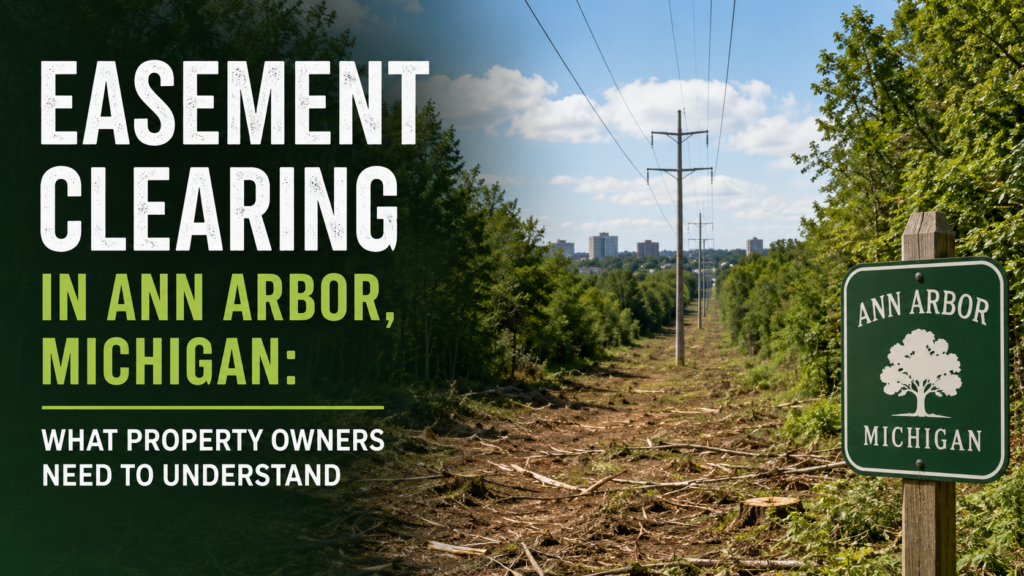
Ann Arbor, Michigan is a city where property boundaries, utility infrastructure, and land rights intersect in ways that matter significantly to property owners. One of the most frequently misunderstood aspects of property ownership in Ann Arbor and surrounding Washtenaw County is the concept of easements and the clearing responsibilities that accompany them. Whether you own a residential lot in Burns Park, a commercial parcel along Plymouth Road, or rural acreage on the edges of the city, easements likely exist on your property and understanding what they are, who is responsible for maintaining them, and what Easement Clearing Ann Arbor involves is essential knowledge.
What Is an Easement?
An easement is a legal right granted to one party to use another party property for a specific, limited purpose without owning that property. In Michigan, easements are extremely common and appear in nearly every real estate transaction. They are documented in deeds, plat maps, and recorded instruments at the Washtenaw County Register of Deeds, and they run with the land, meaning they transfer automatically when the property changes ownership. Common types in the Ann Arbor area include utility easements for electric, gas, water, sewer and telecommunications companies; access easements allowing specific parties to cross or use portions of a property; drainage easements permitting stormwater flow across defined corridors; conservation easements protecting natural features; and pipeline easements for gas or water transmission lines.
What Is Easement Clearing?
Easement clearing refers to the removal of vegetation, debris, trees, shrubs, and other growth from within an easement corridor to maintain the easement holder ability to access, inspect, and perform work within that area. For overhead electric utility easements, clearing removes trees and branches that could contact lines or cause outages. For buried utility easements, clearing provides equipment access for locating, excavating, and repairing lines. For access and drainage easements, clearing keeps the corridor navigable and functional.
Who Is Responsible for Easement Clearing in Michigan?
Michigan law generally places responsibility for maintaining an easement on the party who benefits from it, the easement holder rather than the property owner through whose land the easement runs. DTE Energy is typically responsible for clearing its electric easements. Consumers Energy is responsible for gas line easement maintenance. The City of Ann Arbor or Washtenaw County may hold responsibility for drainage easement maintenance. Michigan Compiled Law 560.190, part of the Land Division Act, specifies that public utilities have the right to trim or remove trees that interfere with their use of easements. However, specific easement agreements can modify these general rules and place some clearing obligations on the property owner. When the responsibility is unclear, reviewing the recorded easement document at the Washtenaw County Register of Deeds and consulting a Michigan real estate attorney is the appropriate step.
When Property Owners Initiate Clearing
Even when the easement holder bears legal responsibility, Ann Arbor property owners sometimes initiate clearing for practical reasons. A utility company standard maintenance cycle may not address overgrowth quickly enough. An access easement may become impassable before scheduled maintenance occurs. A property owner may want the easement corridor clearly visible before selling the property. Development projects may require precise knowledge of buried utility locations before MISS DIG can effectively mark lines. Each of these scenarios may prompt a property owner to engage a land clearing contractor to address the overgrowth.
The MISS DIG 811 Requirement
Before any ground disturbance within or near an easement in Michigan, state law requires notification to MISS DIG 811 at least three business days in advance. This triggers utility locating in which utility companies mark the locations of their buried infrastructure with color-coded flags or paint. This requirement applies to all excavation activity including stump removal and root cutting within easement corridors, and it protects workers from the serious and potentially fatal consequences of striking buried gas, electric, water, or telecommunications lines.
The Clearing Process
Professional easement clearing in Ann Arbor follows a defined sequence. The easement location and width are confirmed from recorded documents. MISS DIG notification is made and utility marks are obtained. Vegetation within the easement corridor is removed using appropriate equipment including forestry mulchers, chainsaws, and brush cutters selected based on the density of growth and proximity to buried or overhead infrastructure. Stumps may be ground to below grade or removed entirely depending on the intended use of the corridor. All cleared material is removed and disposed of appropriately. Disturbed soil is stabilized through seeding or erosion blanket application, particularly important in areas adjacent to Ann Arbor stream corridors and drainage features.
Ann Arbor Tree Considerations
Ann Arbor urban tree canopy is one of the city most valued environmental features, and easement clearing in residential and commercial areas requires sensitivity to tree preservation. Ann Arbor has a robust Urban Forestry program and in some cases tree removal permits are required before certain trees can be removed even within private property easements. Property owners planning significant easement clearing should check with the City of Ann Arbor Planning and Development Services department regarding applicable tree removal permit requirements before proceeding.
Conclusion
Easement clearing in Ann Arbor is a land management service with legal, practical, and environmental dimensions. Knowing what types of easements exist on your property, who bears responsibility for their maintenance under Michigan law, and what clearing involves correctly helps property owners navigate easement issues with confidence. When questions arise about specific easement rights and obligations, consulting the recorded easement document and a Michigan real estate attorney ensures sound decisions about your property.